For as long as I can remember, my father was a stamp collector. When my siblings and I were small, we would go with him to a stamp auction house in Harrisburg, PA when we would be visiting relatives. The auction house was always full and the stamp lots would be on the tables for the collectors to look at before the auction started. Just before auction time, my dad would take us aside and would warn us with the following…”Do not move, do not scratch your face, do not speak…”. You get the picture. We were quiet as church mice.
When the digital age arrived, he was off and running, buying stamp lots from around the world. Two of my brothers are stamp collectors as well. Dad even had a business on eBay. When my father passed in 2007, my mom took over the business with the help of my one brother. When she passed in 2024, that brother drove home from Florida with 46 boxes of stamps.
My two brothers are now going through the boxes and still have a good portion to go through. Recently, after discovering I had a small collection of first day issue covers (issued by the postal service on the first day of issue, on an envelope with first day of issue cancellation across the stamp and a nice cachet on the left hand side), my brothers gave me several boxes of first day covers. I took them home and began going though them.
Now, as a collector of stamps that are not attached to an envelope, you pretty much know what you’re getting right from the get go, but with first day covers, it’s a whole other ballgame and this ballgame just became astounding.
I discovered a group of covers addressed to a Dr. Meyer M. Melicow. Being the “genie” kind of guy I am, I began researching him. He was a doctor associated with Columbia University and is considered the father of uropatholgy. He discovered cancers that affect the urinary system.
Dr. Melicow was also a first day cover enthusiast. The 21 piece collection of covers, letters and post cards I found of his solidified the research that I did on him and his life. The two main standout pieces of the group completely blew me away. The first was a first day cover of the 100th anniversary of the birth of Joseph Pulitzer with a signed letter inside from the dean of Columbia University, Carl W. Ackerman, describing how he was able to persuade the postal service to create the stamp and first day cover, and the dean actually helping in the design of the stamp. The second piece is a simple postard of a sail boat on a lake in the Netherlands. On the back a simple note to Dr. Melicow. The note saying “Seeing Holland and Belgium. Going to England next week. Love, Elliot Porter”. If you don’t know who Elliot Porter is, he was a former doctor that worked at the same hospital that Dr. Melicow worked at in the early days of Dr. Melicow’s career before he became a famed photographer. He knew the likes of Ansel Adams and Georgia O’Keefe.
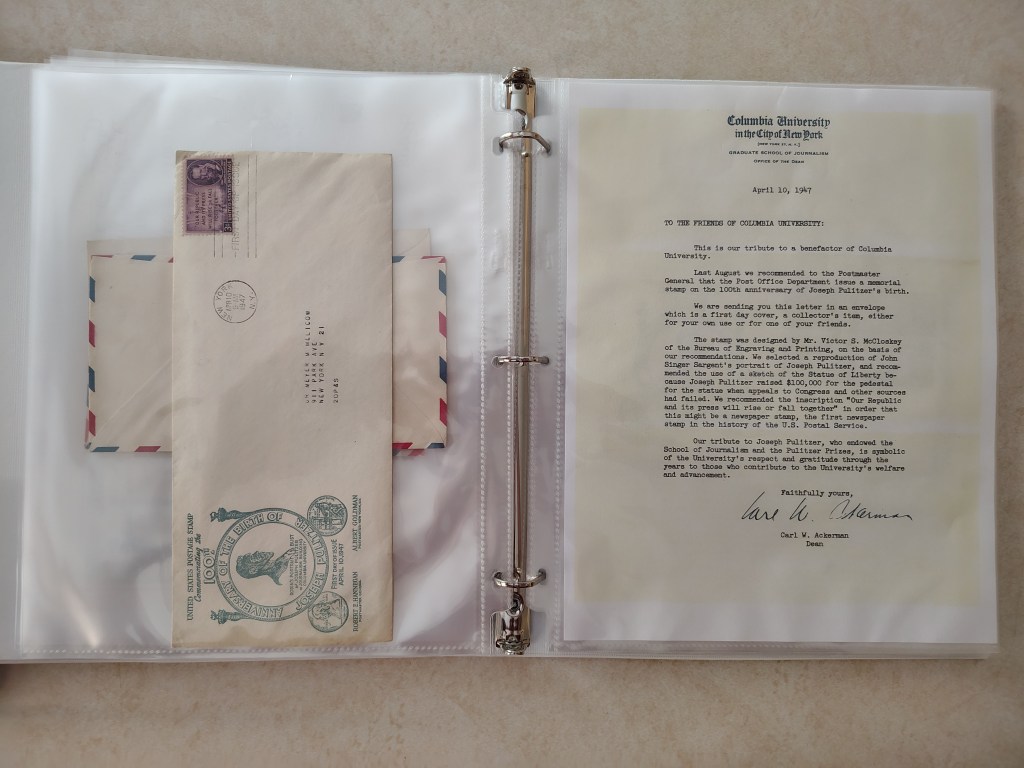
Signed letter from Dean Carl W. Ackerman to Dr. Melicow. The letter shown is a scanned copy. The actual letter is inside the envelope.
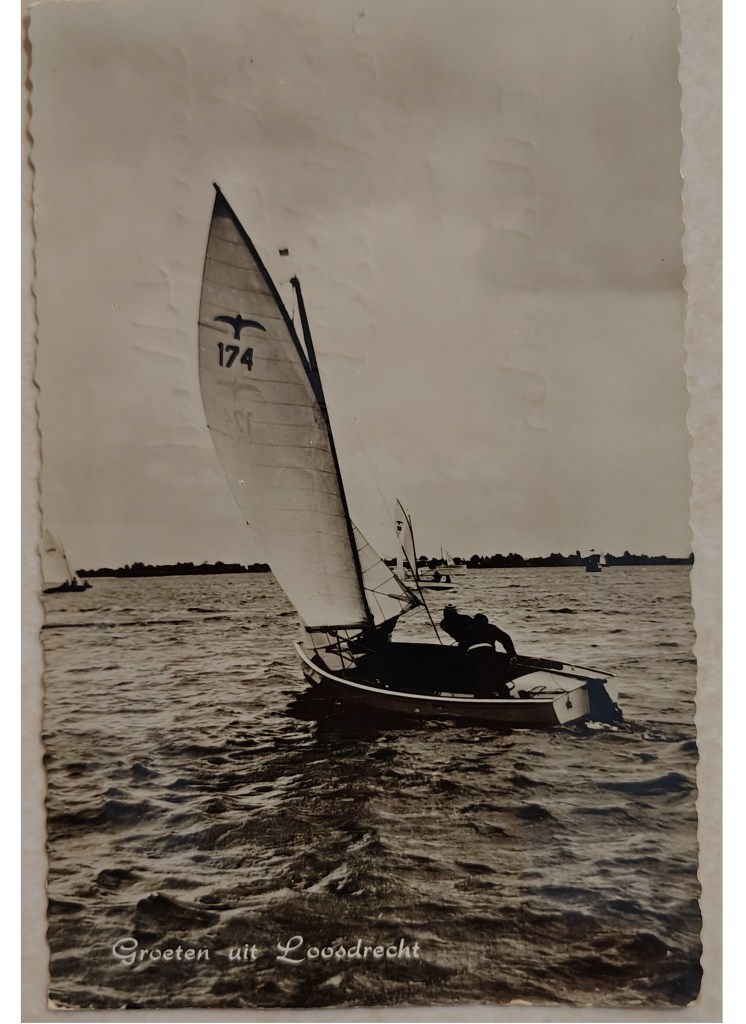
The front of the post card of Loosdrecht Lakes in the Netherlands.
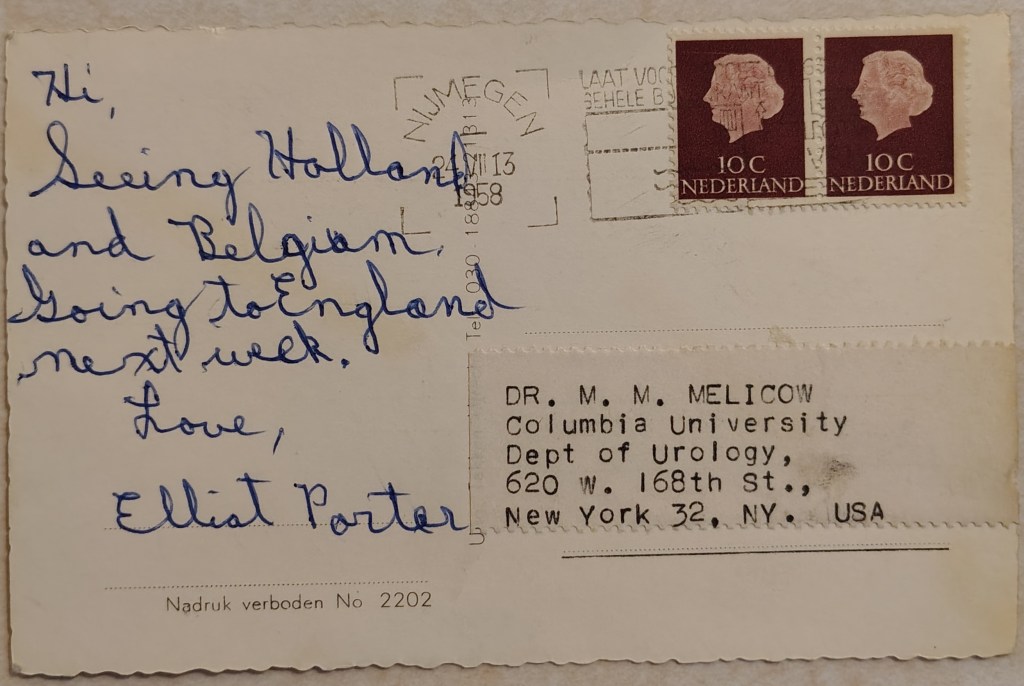
The “Love, Elliot Porter” would mean that Elliot had a deep and meaningful connection with Dr. Melicow. Dated 1958.
These two pieces alone make this collection invalueable. One of the letters in the collection came from Israel and is written in Hebrew. Dr. Melicow was born in Bielystok, Russia (now part of Poland) in 1894. He died in 1983 at the very medical center where he practiced.
The next collection I found was even more surprising…
In another box of first day covers given to me by my brothers, I found a simple first day cover of a set of two horizontally connected stamps of Henry Wadsworth Longfellow. On the left side of the cover is a simple cachet of the Longfellow House and it is addressed to a Mrs. Joseph B. Drummond.
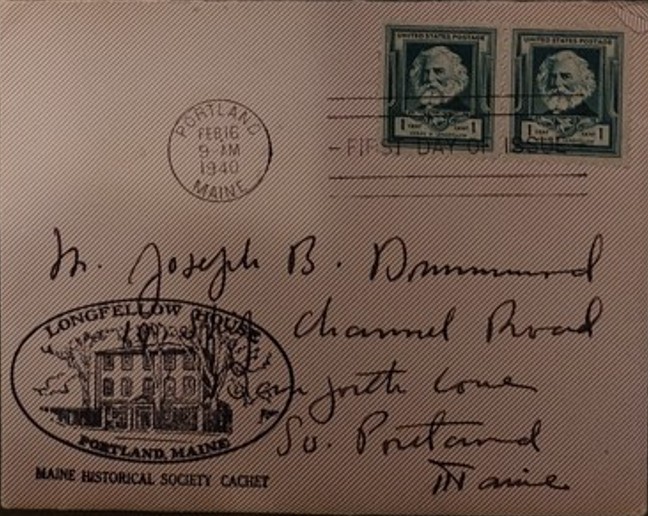
Issued on Feb. 16, 1940. Take careful note of how the capital M in the word Maine is written. It plays a significant role in authentication and provenance of this collection.
What I found next inside was so surprising and so surreal.
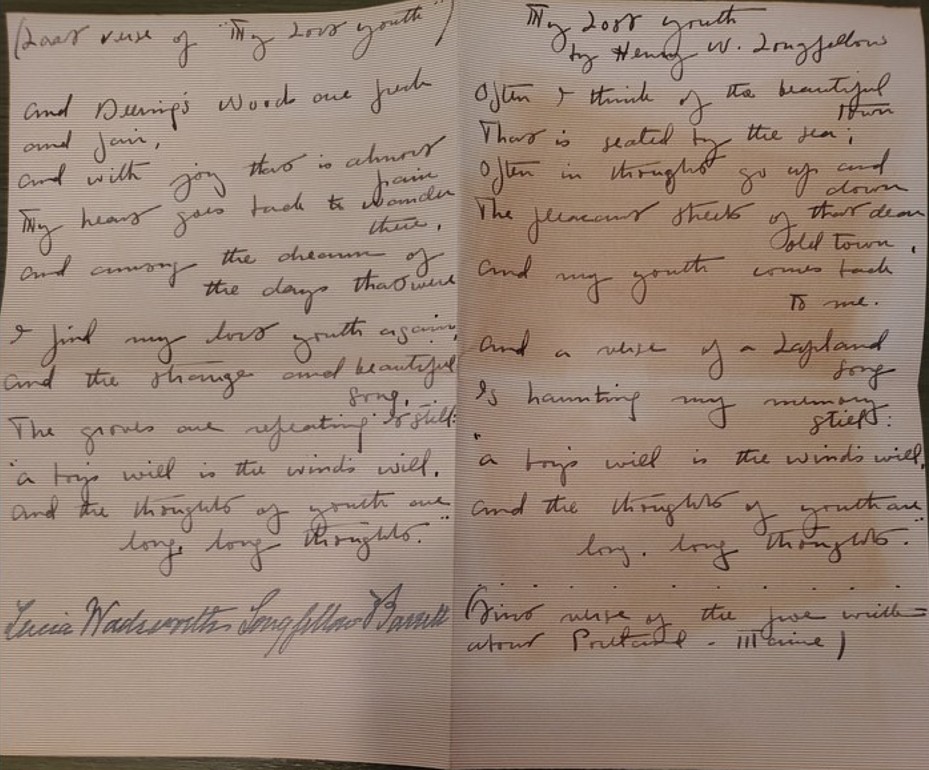
This is a handwritten letter and poem excerpt. The letter is on the reverse. This partial poem is of Longfellow’s poem, “My Lost Youth”. It is the first and last verses of that poem. Again, notice the capital Ms. The poem is signed by Lucia Wadsworth Longfellow Barrett, niece of Henry Wadsworth Longfellow.
It gets even better…on the reverse is a letter from Mrs. Drummond (her full name is Katherine Randall Drummond) to Joseph, her husband.
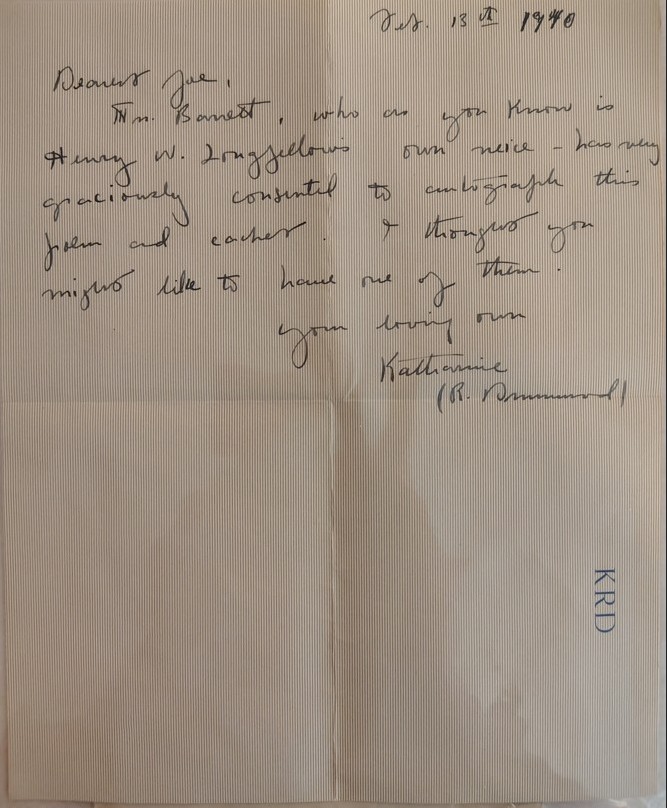
Do you see how the capital M is written for Mrs. Barrett. This entire document was written by Katherine, as you can see what she tells her husband. You will also notice how she states “thought you might like to have one of them”. This means there was more than one, but I would venture to guess not many. Probably just limited to family members. Also notice that it is on Katherine’s own stationery and it matches the envelope. That means that Katherine had the post office use her stationery for this first day cover set that she created for family members, which makes it that much more special, but this one is extra special because of the letter on the back to her husband Joseph.
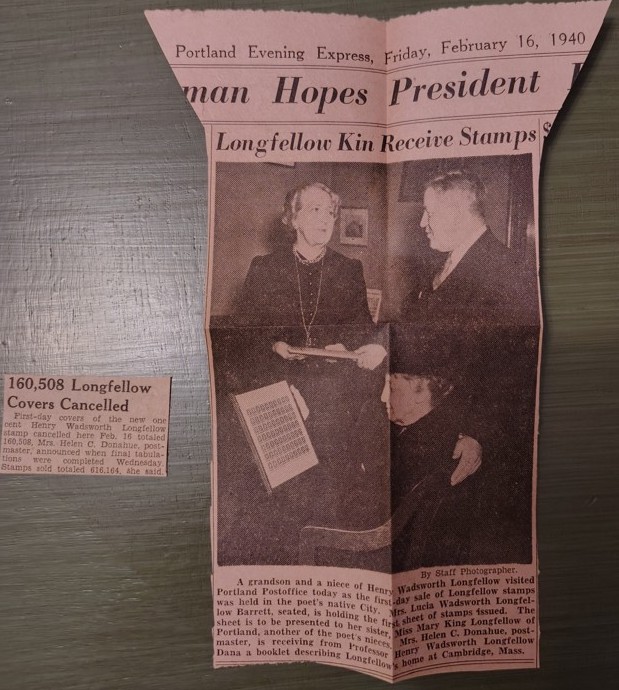
There were also newspaper clippings describing Lucia Wadsworth Longfellow Barrett (seated, holding the first sheet of Longfellow stamps to be printed) and a grandson of Longfellows’, Prof. Henry Wadsworth Longfellow Dana, and the postmaster at the time, a woman named Mrs. Helen C. Donohue. I suspect that Katherine was also present at the Portland Post Office.
Another first day cover in this collection also was used to commemorate Longfellow using the same stamp and cachet. What makes this one different is it was created for the Canal Bank in Portland and on the inside was a special insert with the complete poem “My Lost Youth” by Longfellow.
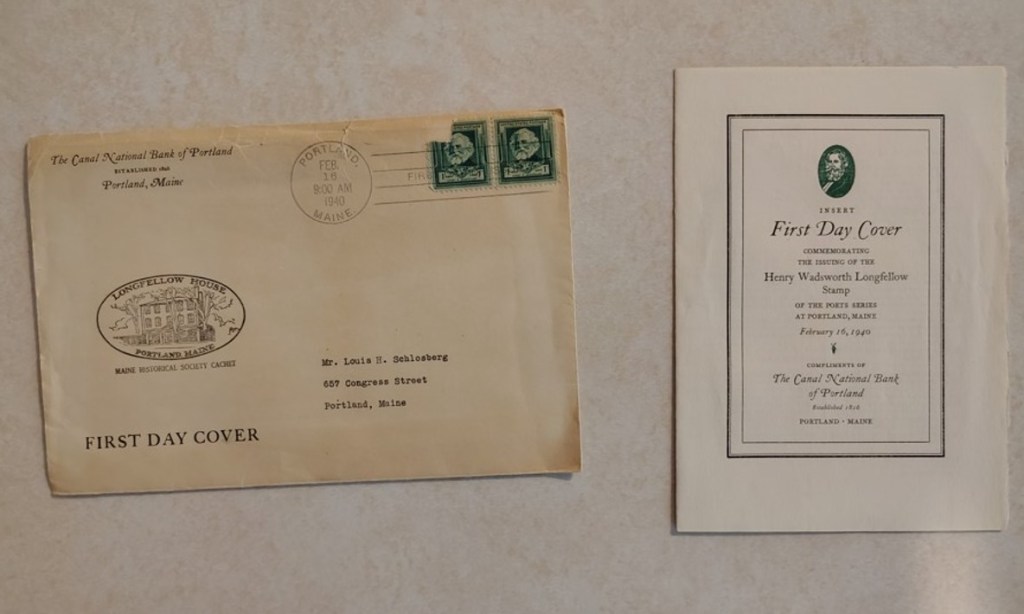
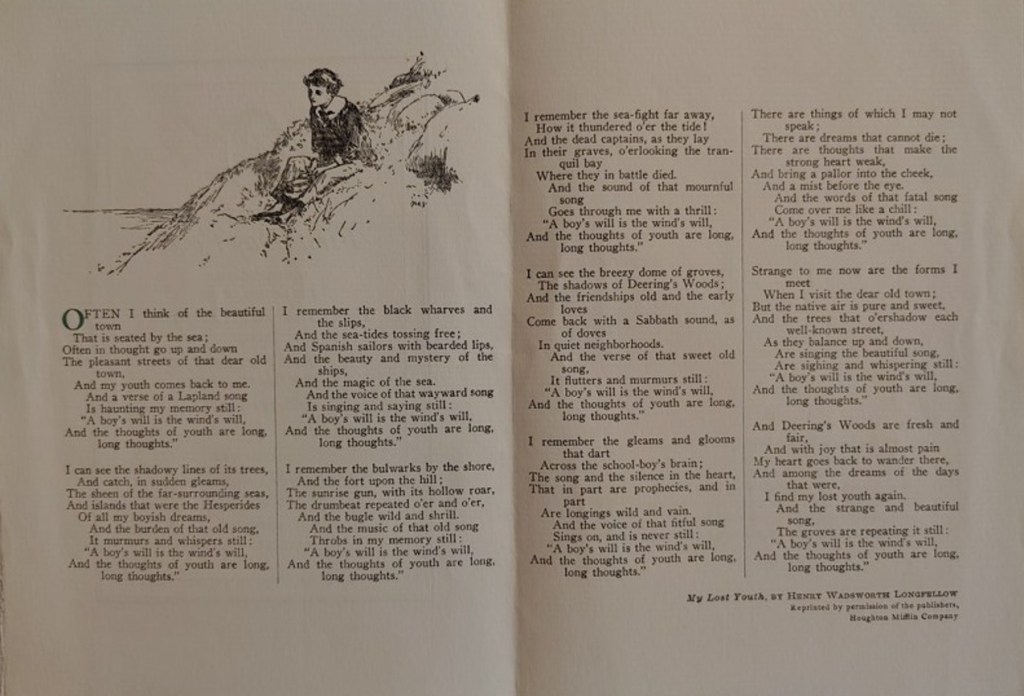
Again more provenance and historical value being added to this collection.
Another cover that came to Katherine 20 years later was from an obvious friend due to the nature of the letter. You will notice that it is typewritten and the name in the beginning salutation is crossed out and Katherine’s name added. This was a common practice when people traveled and corresponded. Almost like form letters but carried personal information. What’s so special about this letter is it came from a woman named Susan Buzzell Ricker, the aunt of acclaimed and Pulitzer prize winning poet and playwright, Edna St. Vincent Millay (she is the one that termed the phrase “my candle burning at both ends”).
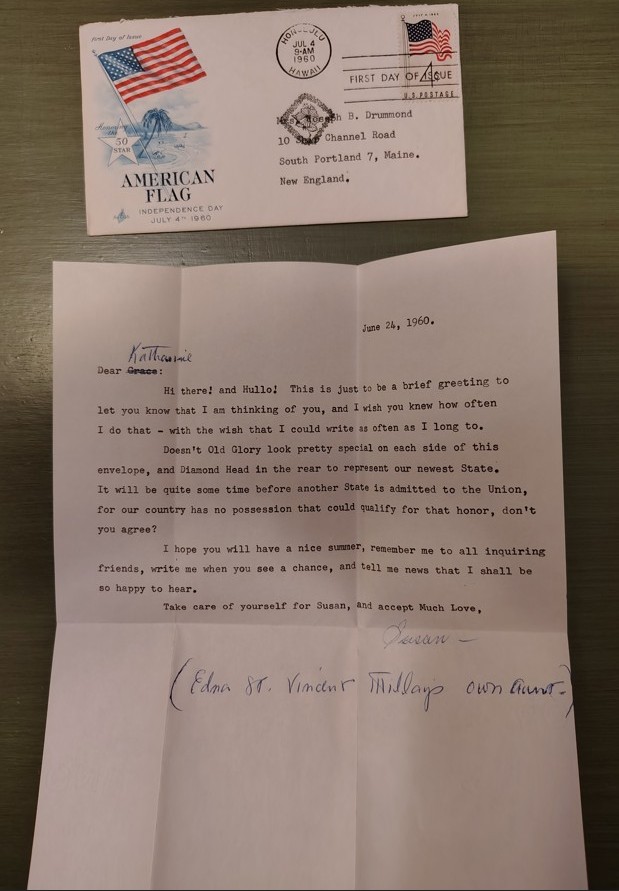
Again, notice how the capital M is written in Edna’s last name.
There is another set of five first day covers that I am not showing here that were addressed to Elgin Gilman, Katherine’s son-in-law, and each cover has a signed letter in them from WGAN radio, the one very special cover is from England, “hands across the sea” mentioned in the letter since the cover is of Queen Elizabeth’s coronation. This letter is signed by Creighton Getchall, vice president of the radio station. This adds more provenance to this collection.
Some other details I discovered about Joseph and Katherine Drummond is quite fascinating. Joseph was a doctor that owned the State Street Hospital. When he died in 1955, it was willed to Katherine who then in 1957, sold it. They had two residences. One in Portland which is now part of the Portland Museum of Art and the second residence is in South Portland on 10 Ship Channel Road (look it up on Google street view-it will blow your mind). This second residence is now called the Sea Rose, a luxury getaway with three rooms. The Dr. Joseph and Katherine Drummond room, the Barbara Drummond room (daughter) and the DeeDee Brown room (a cousin).
The college in Portland, Bowdoin College is where Dr. Drummond went. There is now an endowment in Joseph and Katherine Drummonds name and it’s present worth is $2.9 billion.
Last note…the box I found these in gave up one last secret. The entire box of covers and letters belonged to Katherine Randall Drummond. This collection’s historical value is obviously off the charts.
As it says in the title of this post, the treasures of history can be hidden in plain sight. Just as in genealogy, ancestors can be hidden treasures as well. My hobby of collecting first day covers has just been taken to a whole new level. If there is anyone out there that has an idea of what these two collections may be worth…I’m listening!
Brian S. Miller

