In my previous post, I discussed my line of the McClintock family from Pennsylvania and Virginia (WV). During the time of researching for that post, I was poking around the Library of Congress website to see if there was any further information I could find out about the McClintock family, and I made quite a surprising discovery.
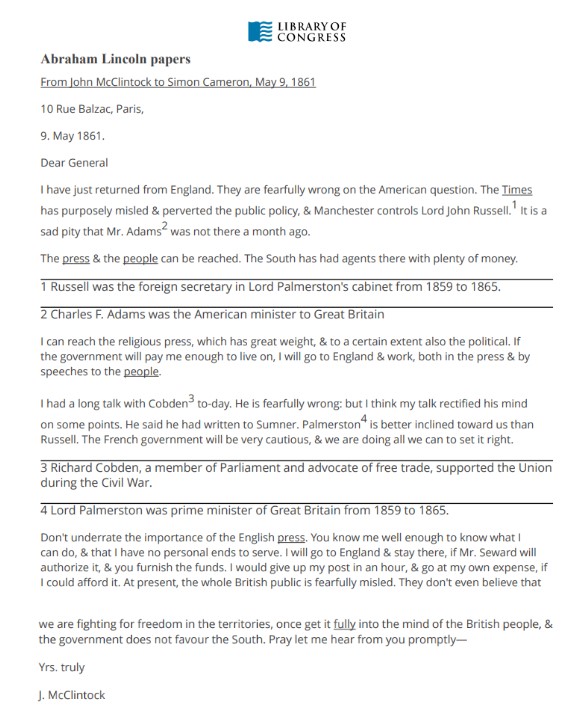
I came across a man named John McClintock, and I found his name in the Abraham Lincoln Papers on the LOC website. He was corresponding with Simon Cameron, who was serving as the Secretary of War under President Lincoln. The date of the letter from John McClintock to Simon Cameron was 9 May, 1861.
The letter reads as follows:
Courtesy of the LOC
So who was this John McClintock? I needed to find out more. I did a Google search on his name and associated it with Paris and the year 1861 and I came up with a gold mine, but first I wanted to get a sense of his beginnings such as when and where he was born. One of the hit results in my Google search gave me his date of birth and date of death…born in 1814 in Philadelphia, PA and died in 1870 in Chatham, New Jersey.
I went to Ancestry© and did a search on his name with this new information and immediately got the information I was looking for.

Courtesy of the Ancestry©
As you can see, John McClintock was 56 years old when he died in March of 1870 of Typhoid Fever. He was born in PA and was a Professor of Theology.
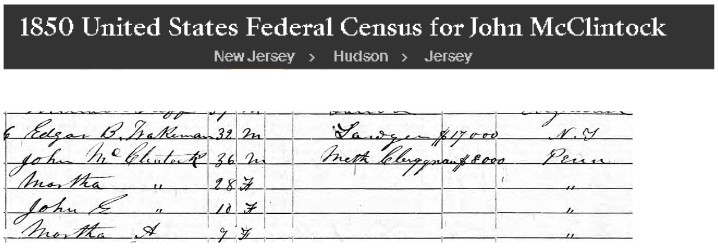
Courtesy of the Ancestry©
According to the 1850 Census above, John McClintock is noted as a Meth. Clergyman. This more than likely stands for Methodist. Based on the other people he is staying with and doing some more searching, Edgar Wakeman listed may have been the brother-in-law to John. John had married Caroline Augusta Wakeman in 1836. Caroline died in March of 1850 in New York. Martha McClintock listed is not John’s wife as the census transcription may have you believe. Martha, I suspect, is John’s sister and the children listed are hers. Her married name was Graydon. At this point I am unsure of any further information regarding them, but my intent here is merely to show where John is in 1850.
So going back to my Google search, one of the first things that caught my eye was this:
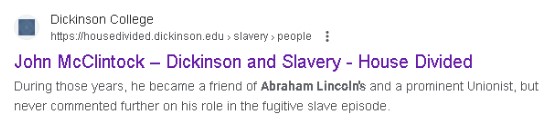
I immediately noticed President Abraham Lincoln’s name and the wording “he became a friend of”.
I clicked on the link and began reading…I was blown away. Here is the link. (Courtesy of Dickinson College.)
The Dickinson College and Slavery issue is related to The Slavery Riot of 1847, which is a well-documented event that brought John McClintock’s name to the forefront of the nation’s news and embroiled him in a trial where he was ultimately acquitted. Still, newspapers around the south were berating Dr. McClintock and the college, and urging southern students attending Dickinson College to leave there and attend southern universities.
John McClintock never really spoke about that event later in life.
Now that I’ve learned that John McClintock was a professor, minister, unionist, abolitionist and a friend of President Lincoln, I wanted to know more about John’s friendship with the President.
I dug further into the Library of Congress and the Abraham Lincoln Papers. I found 2 more correspondences that were from John McClintock to President Lincoln-General Correspondence. 1833-1916: John McClintock to Abraham Lincoln, ND (no date-meeting with Lincoln):
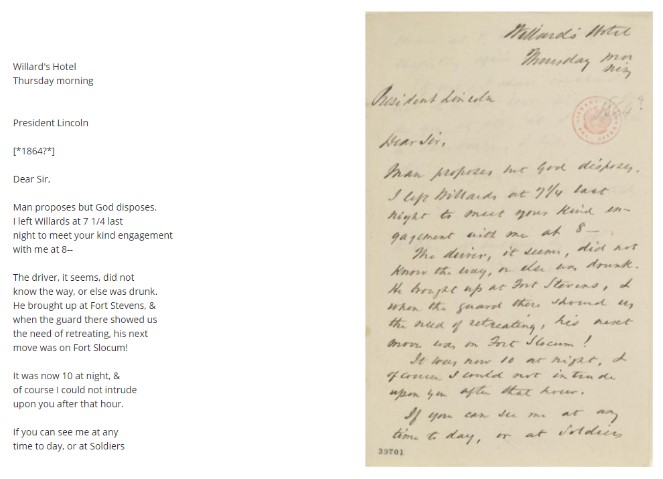

Courtesy of the LOC
The second correspondence I found was this-General Correspondence. 1833-1916: John McClintock to Abraham Lincoln, Tuesday, Feb. 05, 1861 (Writer from Paris urges new diplomatic appointments be made immediately):
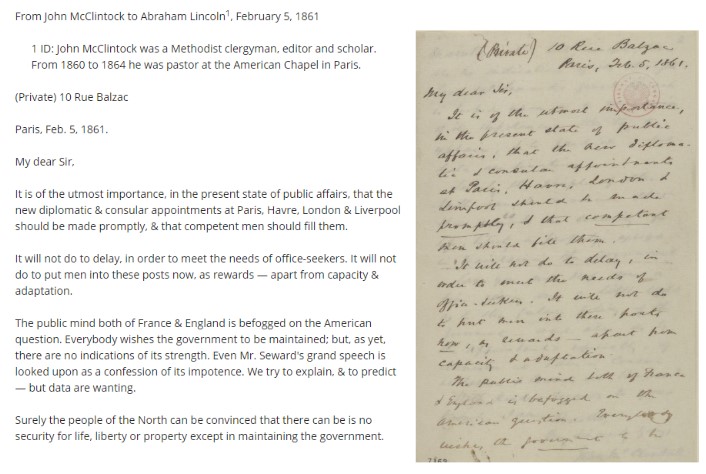
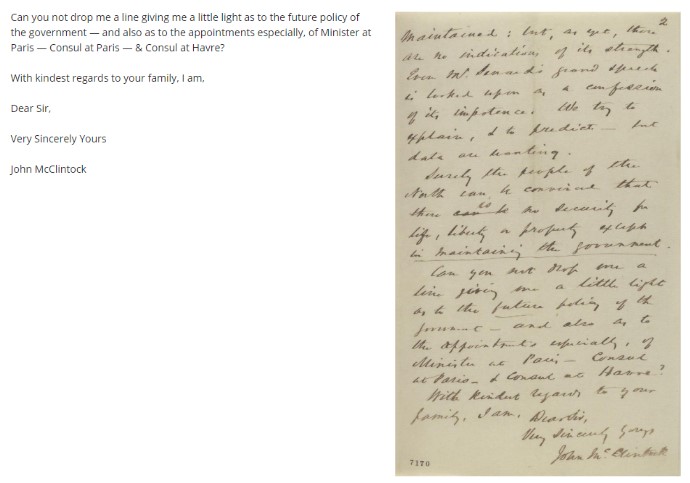
Courtesy of the Library of Congress
Clearly, John McClintock was a man of deep conviction and loyalty to this nation we call the United States of America.
The conversations and correspondences between President Lincoln and John McClintock were not one-sided.
On the day he announced the Draft Emancipation Proclamation to the Cabinet, Mr. Lincoln told Secretary of War Edwin M. Stanton: “Stanton, it would have been too early last spring.”
After issuing the proclamation, President Lincoln told the Rev. John McClintock “Ah, Providence is stronger than either you or I. When I issued that proclamation, I was in great doubt about it myself. I did not think that the people had been quite educated up to it, and I feared its effects upon the border states. Yet I think it was right. I knew it would help our cause in Europe, and I trusted in God and did it.” President Lincoln had thought deeply about the potential implications of the Emancipation Proclamation. He responded to criticism of the impact of the Emancipation Proclamation on the war effort by telling Union Army Sergeant James M. Stradling in March 1863:
“The proclamation was, as you state, very near to my heart. I thought about it and studied it in all its phases long before I began to put it on paper. I expected many soldiers would desert when the proclamation was issued, and I expected many who care nothing for the colored man would seize upon the proclamation as an excuse for deserting. I did not believe the number of deserters would materially affect the army. On other hand, the issuing of the proclamation would probably bring into the ranks many who otherwise would not volunteer.”
“After I had made up my mind to issue it, I commenced to put my thoughts on paper, and it took me many days before I succeeded in getting it into shape so that it suited me. Please explain to your comrades that the proclamation was issued for two reasons. The first and chief reason was this, I felt a great impulse moving me to do justice to five or six millions of people. The second reason was that I believed it would be a club in our hands with which we could whack the rebels. In other words, it would shorten the war. I believed that under the Constitution I had a right to issue the proclamation as a ‘military necessity.’ “
Courtesy of mrlincolnandfreedom.org/civilwar
On the day of President Lincoln’s funeral, 19 April, 1865, Rev. John McClintock delivered a discourse for his friend at St. Paul’s Church in New York.
Courtesy of rememberinglincoln.fords.org
I now want to concentrate on Rev. John McClintock’s family and reveal records, both primary and secondary that will help trace this family back to Ireland and a a connection to a relative that I have mentioned before.
Here is the 1850 Census for a John McClintock in North Mulberry Ward, Philadelphia, PA:
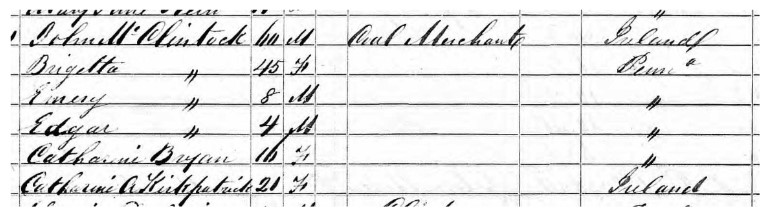
Courtesy of Ancestry©
I believe the John McClintock in the 1850 Census above to be the Rev. John McClintock’s father. Here is why:

McClintock Genealogy – Reprinted from Volume One of The Genealogical Register – Edited by William M. Mervine – Here is the link to the book: McClintock Genealogy
So from the 1850 Census and the above information given, we can surmise that this is the one in the same John McClintock.
Also, the children are named in the McClintock Genealogy book:
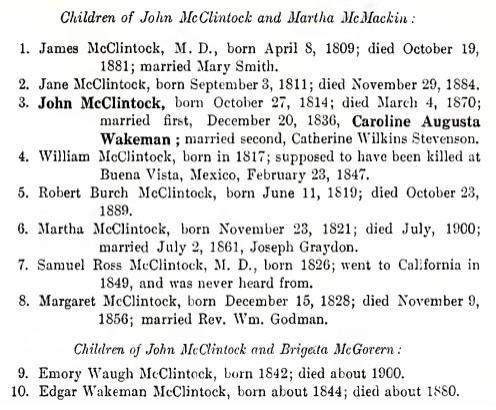
McClintock Genealogy – Reprinted from Volume One of The Genealogical Register – Edited by William M. Mervine
I also found this immigration record that may coincide with the arrival of the John McClintock mentioned above to Philadelphia:
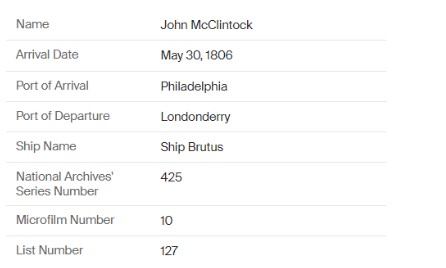
Courtesy of Ancestry©
Another find that may confirm the above information is from Find a Grave:
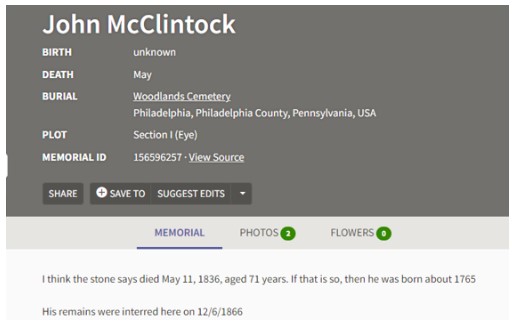
Courtesy of Find a Grave©
I do believe that the information given on the Find a Grave page above was not interpretted correctly as the person that input the information stated that John McClintock died in 1836.
I will tell you that there are headstone photographs associated with this memorial page, but the manager of the page has copyrighted all the photos and unless the photos are being used for an Ancestry family tree page, permission must be given by the page manager, who has disabled sending messages through Find a Grave.
The next best thing for me to do is to describe the names and dates on the headstone.
At the top of the headstone it reads (to the best of my ability):
“In memory (or memoriam) of Martha McClintock” (can’t make out what reads below this).
There’s a dividing line, then it reads (using a 2nd photograph that was taken from the bottom half of the headstone):
“John McClintock, died May 24, 1856” and based on the bio above, if he was 71 years old when he died, that would make his YOB 1784-1785, which mirrors what’s in the book extract above.
Another dividing line, then it reads:
“Rebecca McMackin, died January 21, ????” (the year it looks like 1819, but could be wrong)
The next line I read as “Aged 96 years”
Dividing line, then reads:
“Robert B. McClintock”
“1819-1889”
Dividing line, then it reads:
“Jane McClintock”
“1811-1884”
These names concur with the information given in the McClintock Genealogy book.
Based on the rest of the book and if it is correct, the following would be the connection between this line of the McClintocks and Irish author and historian, James “Turtle” McClintock Bunbury:
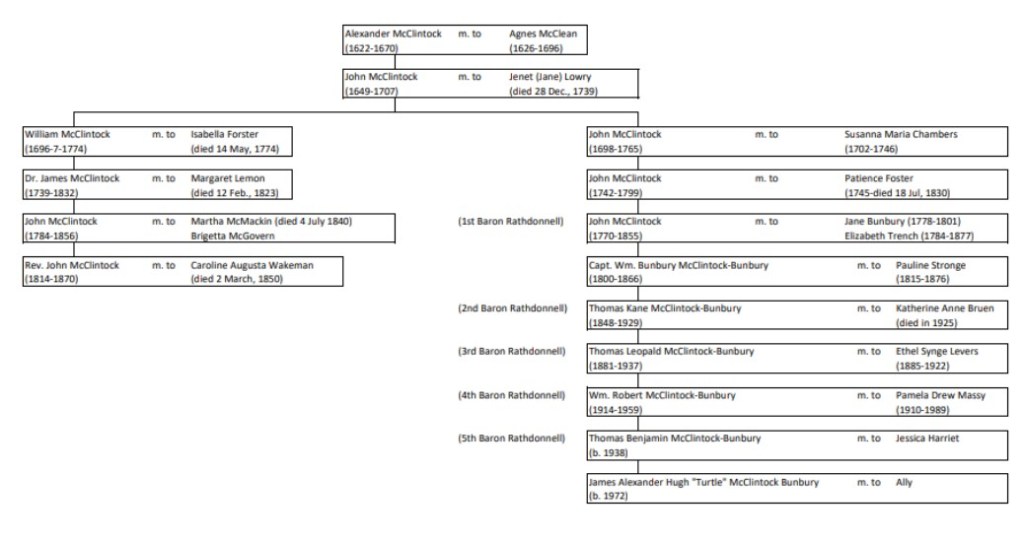
Turtle Bunbury and Rev. John McClintock would be 3rd cousins, 5x removed.
Sources:
Ancestry©
Newspapers©
Wikitree
Turtlebunbury.com®
Dickinson College
mrlincolnand freedom.org
Featured Image
Hammond’s birds-eye view map of Philadelphia and vicinity – C.S. Hammnd & Company – 1926
Courtesy of the Library of Congress
Acknowledgements:
Alison McClintock
Grant McClintock
Jack McClintic
Turtle Bunbury
Cheryl, my wife who keeps me centered and whose love I cannot live without!
Brian


That is a super cool find!
LikeLike
Thanks TJ!
LikeLike
I’ve also seen photographs on Find A Grave that contradict the information on the memorial. It can cause more confusion or if evaluated correctly can clear up the confusion. Good work, Brian.
LikeLiked by 1 person
Cathy, Thank you…one of my other mentors, Turtle Bunbury gave me the inspiration for this post. He has been a cheerleader since I got to know him a number of years ago. Thanks again for your comments and friendship!
LikeLiked by 1 person
I am descended from James McClintock, M.D., Rev. McClintock’s brother. Feel free to hit me up if you have any questions concerning the McClintock family. There are a lot of “Williams’, Johns’, James’ and Alexanders'” so it can be a bit confusing.
LikeLike
Hi Tom,
It’s funny, I am also descended from a James McClintock, but I know it is not the same one. I am very good friends with Turtle Bunbury, who is descended from your same McClintock line. I just haven’t been able to prove that yours and Turtle’s McClintocks are realted to mine. Thanks and I’ll take you up on your offer! Brian
LikeLike