On 19 September 1732, 291 years ago today, my ancestors, Johan Jacob Mueller, his wife Catharina Charlotta and their son Jacob and possibly another older son, took their first steps upon American soil.
In celebrating my 100th post, I wanted to go back in time before their immigration, back to the earliest known village of origin for my Miller family. That origin begins with the marriage record of Johan Jacob Muller and Catharina Charlotta Lochner.
The term origin is defined as the point or place where something begins, arises or is derived. Every human being on this planet, past or present, has or has had a place of origin. One of the most challenging tasks in researching ancestors that have origins on distant shores is locating their place or village of origin. The primary records are your best chance for finding their origins, but locating those records is also part of that research challenge. Another challenge is, if your ancestor lived in a country such as France or Germany, it is crucial that you translate the language the primary records were recorded in and that should be your first step. Google has a good built in translation tool. Just do a search for Google German or French to English translation.
My very first post back in 2017 was about the confusion between the different Miller families from Germany that immigrated to America. In that post, I brought forward translated secondary records I had received from a friend of mine. The first were birth records for some of the children of my Miller ancestors, Johan Jacob Muller and Catharina Charlotta Lochner, and the second was the marriage record for Jacob and Charlotta from 1720. Here is the secondary translated marriage record:
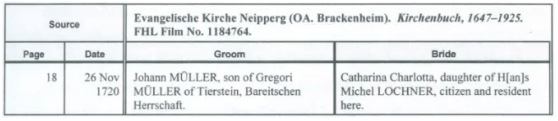
The information contained in this record is very revealing, but only if it is true and translated correctly. Here is what I did first when I was trying to translate this record. I wanted to verify the place of origin for Jacob’s father, Gregori Muller. I did a search for Tierstein. What comes up is Thierstein, Germany. I don’t believe this is the village, since Thierstein is roughly 300 km (about 186 miles) away from the area where Jacob and Charlotta were getting married. It’s possible but I have my doubts.
When I did a search on the word after Tierstein, Bareitschen, Google gave me this translation – “bare whip”. The next word, Herrschaft translated as “domination”. I’ll wait until you’re done laughing…I then went to my copy of The Family Tree German Genealogy Guide by James Beidler, who also happens to be my 6th cousin (advantage…me!). After reading back through his book, I realized that Herrschaft roughly translated means “lord” or “lordship”. The term Bareitschen, being second in the sequence usually refers to a noble family that probably ruled the mentioned village, Tierstein, but according to Jim, the word Bareitschen in the marriage record is an “adjectival form of the word that likely wouldn’t have been used in the surname of the nobles, so it seems like a double-edged sword.”
I needed to approach this from another angle. I knew I had to go to the source location for the primary records because I needed to know which Tierstein village in Germany the record was indicating.
I engaged the further assistance of a friend of mine, John Kurt Entsminger, who narrowed down the two villages to Tierstein, Dietingen, Rottweil, Germany and Teirstein, Schramberg, Rottweil, Germany.
I also got confirmation from John that the translation of the actual 1720 marriage record to the current translation record that I have is correct.
From this point, I knew from what I had learned from Jim and John, I had to contact the archival and historical agencies of Rottweil and Schramberg.
I first did a search for any historical associations in the region of Schramberg and came up with:
Museums und Geschichtsverein Schramberg (Schramberg Museum and History Association) and their office passed my request onto the City of Schramberg’s historian and archivist. As I was awaiting a reply from the archivist, I ventured on to contact other agencies.
A nice trick to use is the city’s name you intend to contact and add https:// to the beginning of the name and then add .de to the end like: https://schramberg.de. (Thanks Jim Beidler for this nice little URL trick).
I went on to contact the City of Rottweil City Archives, Fachbereich Kultur, Jugend, Sport und Tourismus (Department of Culture, Youth, Sport and Tourism). Their office asked for the 1720 marriage record, original and translated. After receiving them, their office then redirected me back to the city archivist and gave the archivist’s e-mail address.
I decided to reach out directly to the archivist and sent him the same 1720 marriage record. I am now waiting for a response.
No matter the response or even if I don’t get an answer, the purpose of this endevour is to learn. The journey is just as important if not more so than the destination. Once you go through this experience, it becomes that much easier to get results and you are making great contacts at the same time. The key is patience. Dont’ expect overnight results…sometimes you get lucky and get a fast response, but it’s important to keep in mind that you are contacting someone that may be half way across the globe and they may also not share your appreciation for genealogical research. It’s also important not to rely on one source…try to look for many different sources as you can. Never give up though…you won’t find answers with a defeatist attitude. If you feel like you are getting burned out on researching a particular ancestor, put them on the back burner and move onto something else. You can always get back to them when you are refreshed.
I know for a lot of us, physically traveling to a prospective village of origin or area thereof that may hold the records we seek is not possible, but reaching out in our digital age is the next best thing.
Sources:
Ancestry©
James L. Beidler (https://jamesmbeidler.com/) – The Family Tree German Genealogy Guide & Trace Your German Roots Online
John Kurt Entsminger
Schramberg Museum and History Association
Schramberg Historian and Archivist
The Courthouse of Rottweil City Archives, Department of Culture, Youth, Sport and Tourism
Feature Image:
Tierstein, Dietingen, Rottweil, Germany – courtesy of Google Maps Street View
Here is a description from the archivist at the court house in Rottweil about the two Tierstein locations.
Tierstein, Dietingen – A farm estate
According to the 1875 book Description of Oberamts Rottweil, in the area of the village of Dietingen (Municipality of Dietingen near Rottweil), there was a Thierstein farm that was “half an hour southwest of Dietingen, up on the steep rocky slope of the Neckar river. The farm was quite large which was the property of Postmaster Platz. The farm had 285 acres of fields, 40 acres of meadows and 20 acres of forest.”
Here is another view of Tierstein, Dietingen courtesy of Google Maps Street View:

Beautiful, isn’t it?
Tierstein, Schamberg – A village near Schamberg
According to the book “Description of the Oberamts Oberndorf” published in 1868, there was a hamlet of Thierstein near Schramberg, which was half an hour north of Schramberg.
The archivist continued on to say “We assume that the Thierstein you are looking for, where the father of your ancestor Johan Jacob Mueller came from, is the Thierstein farm near Dietingen. The village of Dietingen and its surroundings belonged to the territory of the imperial city of Rottweil in the 18th century. The hamlet of Thierstein north of Schramberg, on the other hand, belonged to the territory of the Austrian rulership of Schramberg in the 18th century, which at the time was owned by the Counts of Bissingen as a fief. Ultimately, however, a local historian would have to find out whether the hamlet of Thierstein near Schramberg or the Thierstein farm near Dietingen are meant, where the father of your ancestor Johan Jacob Mueller was born.”
Acknowledgements:
This post is dedicated to the memory of Myron M. Miller, who left this world in 2020. Myron became my friend back in the early days of my reseach and was an inspiration to me as he was the one that shared the translated 1720 marriage record of Johan Jacob Mueller and Catharina Charlotta Lochner with me and some of my distant Miller cousins…thank you Myron for passing the torch. I’ll take it from here.
James L. Beidler – Thanks Jim for everything
John Kurt Entsminger – Thanks John for the assist…you’ve been a great help
Cheryl, my wife, my love, constant companion and my rock…I couldn’t do this without you
Brian
 Your Ancestors Demystified
Thanks for posting again about Muellers. I am still trying to find the parents of Henrietta Mueller, born 1796 in Lancaster County, Pennsylvania. She married George Jacob Kurtz before 1824 in Plainfield, Pennsylvania, according to information I received years ago.
LikeLiked by 1 person
Maybe I can track them down. I have many connections and resources in PA. I’ll see if I can find anything.
LikeLike
Congratulations on post #100!
LikeLiked by 1 person
Thank you Cathy!
LikeLike
Just found out today that I am a descendant of Johan Jacob Mueller.
LikeLike
Hello Debra,
I hope everything I have written about the Mueller’s has added to your history and ancestry your are discovering!
It is well worth the trip!
Brian
LikeLike
I was absolutely amazed and appreciate all your work. My father always said he was of German descent but I’m not sure that he even realized when or how his family came to the USA. Thank you!
LikeLike
Debra,
Glad to help! I’ll get back to writing in the near future. Working on my “genie” cert.
Thanks again!
Brian
LikeLike